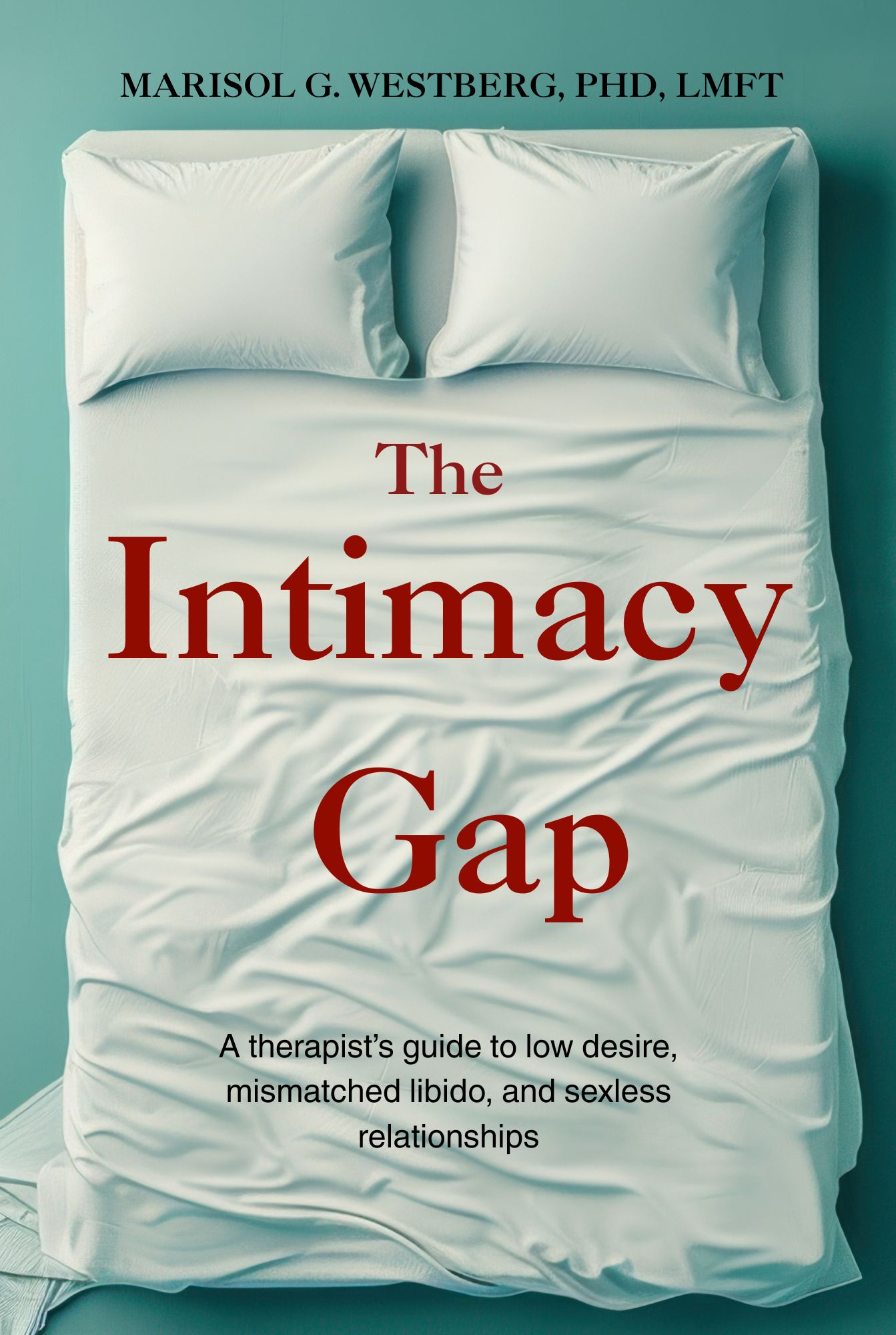
— sexual desire
Understanding when my wife has no desire for sex: causes and solutions
Women’s sexuality can differ significantly from men’s. Certain issues tend to be more common depending on the gender with which one identifies — and understanding what is actually driving low desire is the first step toward addressing it.
Marisol G. Westberg, Ph.D., LMFT
Sex therapist & educator
Factors Influencing Sexual Desire
What actually affects desire
Sexual desire is not purely biological. It sits at the intersection of body, relationship, psychology, history, and social context — all at once.
Physiology
Hormonal changes during menopause and pregnancy, gut-brain connection, and illnesses that cause fatigue and discomfort can all impact sexual desire and well-being.
Relational
Relationship length, intimacy levels, satisfaction, and conflicts such as betrayal all significantly impact desire. Long-term conflict or declining intimacy often leads to reduced sexual interest.
Psychology
Self-esteem, stress, and emotional well-being significantly influence sexual desire and satisfaction, impacting the overall quality of intimate relationships.
Sexual history
Sexual history, current sexual activity, and overall sexual health play crucial roles in determining compatibility and influencing both desire and satisfaction.
Social
Societal narratives and discourses around sex and love profoundly influence individual perceptions and desires, often shaping how sexual relationships are understood and pursued.
Demographics
Age, education level, and socio-economic status shape attitudes toward sex and impact levels of stress and exhaustion — both of which affect desire.
Types of Sexual Desire
Spontaneous vs. responsive desire
Spontaneous desire
Arises naturally without specific triggers — often felt in early relationships or unexpectedly. It reflects an innate drive for sexual activity independent of external stimuli, similar to a sudden craving.
Resp

— how to increase libido
What actually helps
01
Treat each interaction with your partner as if it were a first date — put in effort. Women’s sexual desire often needs an initial spark, and neglecting personal grooming, mood, or presentation can reduce the chances of desire emerging.
02
Only engage in sexual activity when you genuinely want to. Forcing yourself diminishes desire over time — consistently having unwanted sex creates negative associations that compound.
03
Start letting go of thoughts and obligations that are not yours to carry. If you are the higher-desire partner, consider taking on more household and domestic labor to give your partner genuine rest.
04
Learn to communicate in ways that prevent escalation. Address personal issues such as fears of abandonment — these fears drive conflict and push partners further apart.
05
Create more personal space — a separate workspace, time with friends, activities you enjoy independently. Desire often grows when there is room to miss your partner.
06
Take responsibility for your own emotional maturity. Address control and trust issues, and allow your partner to handle their own responsibilities. A healthy adult relationship requires mutual respect and independence.
07
Seek variety within your existing life. Sometimes a simple change — being intimate in a different room, at a different time of day — can introduce enough novelty to shift the dynamic.
08
Work through sexual fears and insecurities. Fearing certain aspects of sexual activity decreases desire — addressing those fears, ideally with professional support, is essential for rebuilding interest.
— case study
Margaret and Toby
Margaret came to see me after her fiancé issued an ultimatum: if she did not sort out her sexual issues, he was going to leave her. He made it clear he was not willing to get married if their sexual relationship did not improve.
Margaret, like many women, had been engaging in sex not out of desire but as a means to avoid conflict or appease her fiancé. She was having sex to get him off her back — not because she genuinely wanted to.
When Toby learned this, his reaction was mixed — he did not want her to feel forced into sex, but he also felt his needs were going unmet. Margaret was caught between not wanting to lose the relationship and a growing aversion to sex that had reached the point of anxiety and dread.
She was trapped in a cycle of obligation and resentment. The more pressure she felt, the more she recoiled. Toby’s ultimatum — though rooted in his own frustration — added to that pressure and made the aversion worse.
In therapy, it became clear that her aversion was not just about the physical act — it was deeply intertwined with her emotions and sense of self. She felt inadequate and guilty for not meeting Toby’s expectations, which deepened her disinterest and created a vicious cycle.
Toby’s role was equally important. He needed to understand that pressuring Margaret into sex — even indirectly, through ultimatums — was contributing to her aversion. The work involved helping both partners rebuild on a foundation of mutual respect rather than obligation and resentment.
The goal was an environment where both felt heard, valued, and free to be themselves — which is the foundation for consensual, fulfilling sexual connection.
Struggling with different
desire levels?My step-by-step course addresses desire discrepancy directly from the comfort of your home. Learn practical tools to reconnect and understand each other’s needs — at your own pace, in complete privacy.
— frequently asked questions
Common questions
Do women like sex?+
Many women enjoy sex, particularly when the concept of sex is broadened to encompass a range of intimate activities, from flirting to more physical interactions. A woman’s interest in sex often grows when she feels rested, experiences low conflict and stress, feels excited, and knows she is cared for and supported.
What is the peak age for sexual desire?+
Sexual desire is often higher in youth due to hormonal surges, novelty, and fewer life pressures like cohabitation, work stress, or parenting. But ultimately, desire peaks at an age where one feels secure, harmonious, excited, and fulfilled — suggesting emotional and situational factors play a significant role.
What is the difference between sexual desire and arousal?+
Desire is a mental interest in sex; arousal is the body’s physical reaction to sexual stimuli. Physical signs of arousal do not necessarily indicate a genuine desire for sex. This distinction is important — someone’s body may react to touch without meaning they consent to or desire that interaction.
How do medications, stress, anxiety, and depression influence libido?+
If your body or environment is undergoing change of any kind, your sexual desire is affected — because for many people, desire is sensitive to changes in their bodies and surroundings. The more important issue is to understand this as normal, rather than feeling slighted or angry that things have changed.
How do you manage mismatched desires?+
Watch this video on the Step-by-Step Process To Increasing Sexual Desire.
Should I see a therapist or couples counselor for sexual dissatisfaction?+
Yes — but find a therapist with expertise in both couples therapy and sexuality. Those two specialisms together are what make the difference.
What is flibanserin (Addyi) and does it work?+
Flibanserin (Addyi) aims to boost sexual desire in premenopausal women by altering brain chemistry. It has notable side effects including dizziness and nausea, and its effectiveness is debated given modest benefits. Focusing on medication may overlook the broader relational and societal factors influencing desire, potentially reinforcing the idea that low desire is purely an individual medical problem.
Why doesn’t my partner want to be intimate with me?+
See: Top 10 Reasons Your Partner Doesn’t Want to Have Sex With You.
Does sexual desire decrease with age?+
Yes and no. See: 11 Myths About Sexual Desire for the full answer.
Do men experience low libido?+
Yes. Many men’s libido is affected by contextual factors such as stress and conflict. Feeling sexually incompetent also appears to be a significant cause of low desire in men.
— work with me
Struggling with desire or mismatched libido?
Therapy can help you understand what is actually driving the disconnect and build a path forward together.
BOOK A SESSION— CE course for therapists
Resolving Desire Discrepancies in Relationships
A 2-CE course covering the clinical framework for working with mismatched desire — assessment, intervention, and relational repair.
VIEW COURSE